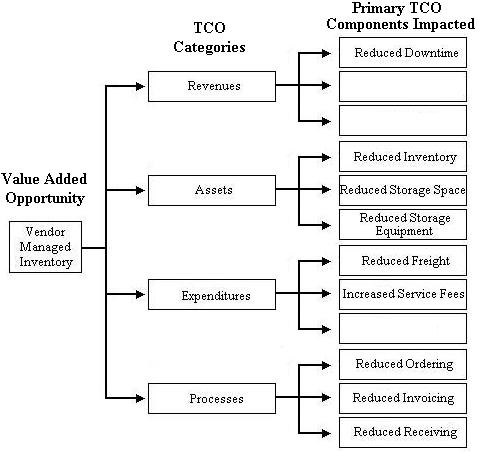
| There are four different Total Cost
Of Ownership (TCO) categories that a supplier could
impact when they manage a customer's inventory:
Revenues - In some cases (not all) a supplier can have
a positive impact on revenues. Through better inventory
management, downtime may be reduced that could allow
the customer to produce more products.
Assets - The obvious asset affected should be a reduction
in inventory levels, either through consignment or improved
turns on items not consigned. Other assets could be
impacted as well, such as storage space and storage/handling
equipment requirements (although usually only to a minimal
extent).
Expenditures - When a supplier manages the customer's
inventories, it usually results in their consolidating
orders that can result in fewer deliveries. If the customer
is charged for freight, this could lower their freight
costs. Additionally, some suppliers charge for this
service, either as a fee or through higher prices. If
true, this savings needs to be included as well.
Processes - Suppliers that manage or help manage their
customer's inventories also reduce the processing costs
for their customers by performing the processes for
them. Typical processes impacted would include: ordering,
invoicing, and receiving/stocking activities.
By using the Impact Diagram below, companies can “sort
out” and visually see the costs that a specific event
impacts. This can make the impact easier to measure.
|